
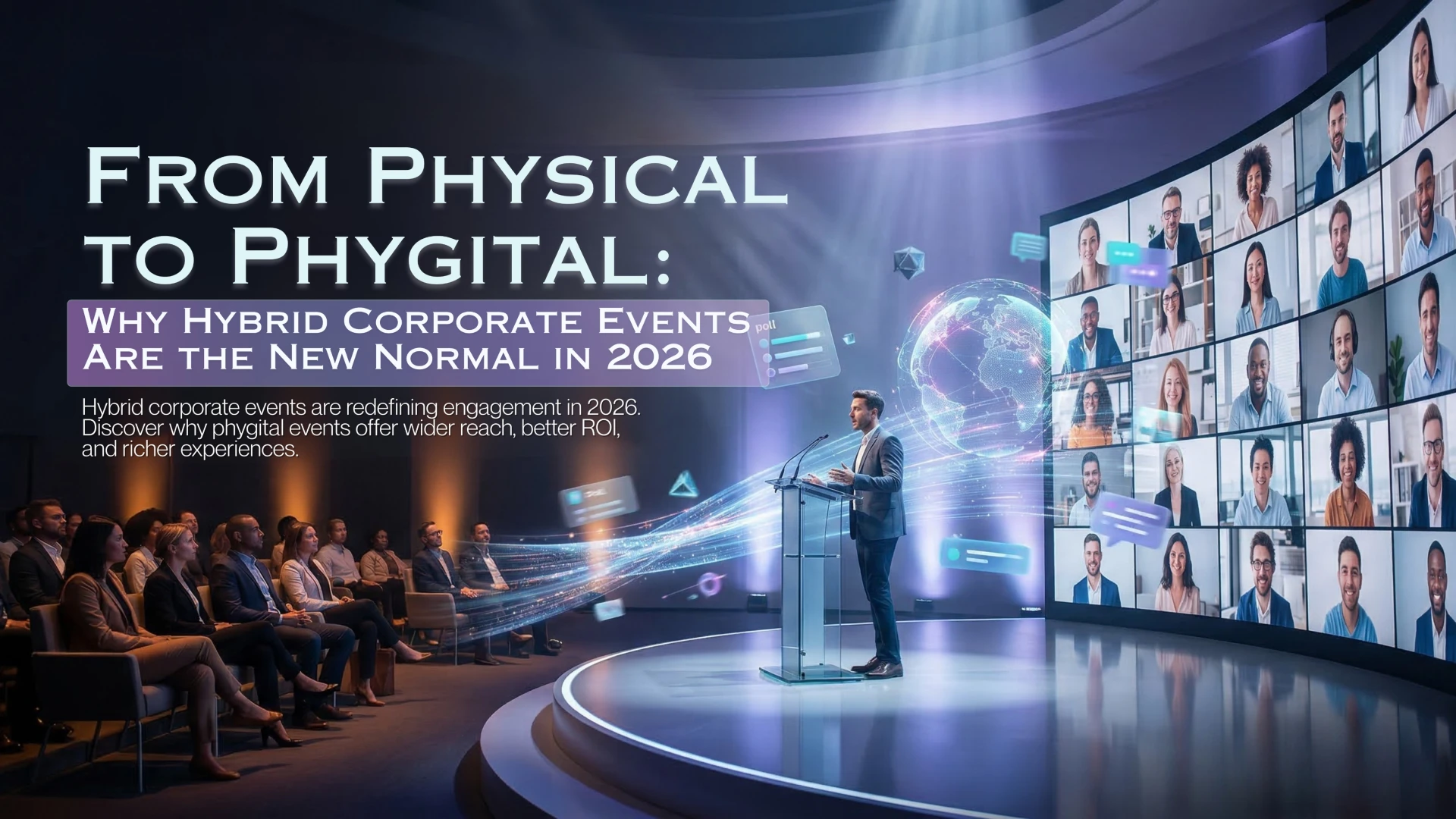
From Physical to Phygital: Why Hybrid Corporate Events Are the New Normal in 2026
A few years ago, corporate events were simple.
You booked a venue.
Send invitations.
Hoped people showed up.
Today, that reality has changed — permanently.
In 2026, events are no longer either physical or virtual. They are phygital — thoughtfully designed experiences that live both on-ground and online. And this shift isn’t about convenience alone. It’s about connection, inclusivity, smarter budgets, and meaningful engagement.
Companies don’t want to choose between reach and experience anymore. They want both. And hybrid events make that possible.
Why Phygital Events Are Trending ?
Let’s be honest: audiences have changed.
Leaders travel less. Teams work across time zones. Stakeholders expect flexibility. And attention spans are shorter than ever.
Hybrid events solve a very real problem — how do you bring people together without limiting participation to a single location?
Furthermore, industry data indicates that hybrid events attract 40, 60% more attendees than traditional fully in person formats, primarily because participants can join from anywhere in the world. Simultaneously, businesses disclose that by cutting down on travel, lodging, and big venue expenditures, they achieve considerable savings.
What’s more, hybrid events have ceased to be regarded as a compromise. They are perceived as a strategy enhancement.
Designing Equal Experiences: No One Should Feel “Secondary”
Perhaps the biggest misunderstanding about hybrid events is that virtual participants are considered nothing more than passive viewers. But in fact, the most successful phygital events are audience centric and not stage centric.
What does that look like?
- Virtual attendees don’t just watch — they interact through live polls, Q&As, chats, and breakout rooms.
- In-person attendees benefit from real-time feedback and audience insights coming from both online and offline participants.
- Sessions are built to be shorter, sharper, and more engaging, respecting modern attention spans.
Studies show that events using live interaction tools see over 30% higher engagement rates than those that rely only on one-way presentations.
The goal isn’t to replicate the physical experience online — it’s to create two equally valuable journeys, connected by smart design.
The Technology Making Hybrid Events Feel Seamless
Technology is the quiet backbone of every successful phygital event.
In 2026, hybrid events rely on tools that go far beyond basic live streaming:
- Unified event platforms organize registrations, sessions, networking, and data analysis all in one place.
- Smart matchmaking powered by AI links participants with relevant peers, speakers, or sessions.
- Real time analytics dashboards provide event organisers with the information about the success of their strategies and the areas that need improvement even during the event.
- Multilingual support and accessibility features turn the events into genuinely worldwide and inclusive ones.
In fact, nearly half of modern event budgets are now allocated to technology, proving that experience matters as much as location.
When done right, tech fades into the background — and connection takes centre stage.
Budget Efficiency Meets Global Participation
Hybrid events aren’t just better experiences — they’re smarter business decisions.
Companies consistently report that hybrid formats:
- Reduce overall event costs
- Increase total attendance
- Generate more qualified leads
- Deliver clearer ROI through measurable engagement data
Instead of hosting one event for one city, brands can now host one event for the world.
This balance of impact and efficiency is exactly why leadership teams are approving hybrid formats faster than ever before.
Best Hybrid Formats for Leadership Meets & Product Launches
Leadership Meets & Town Halls
Hybrid formats work exceptionally well for leadership communication.
A strong structure usually includes:
- A live keynote with simultaneous global streaming
- Interactive polling to capture real-time sentiment
- Breakout discussions for both physical rooms and virtual spaces
This creates alignment across regions while still allowing personal interaction.
Product Launches
Phygital product launches are redefining brand storytelling.
Instead of one-time reveals, brands now offer:
- Live unveilings for on-ground audiences
- Virtual demos and walkthroughs for remote attendees
- On-demand content for post-event engagement
The result? Longer visibility, broader reach, and deeper audience connection.
Why Hybrid Events Are the New Normal — Not a Trend
By 2026:
- Over 70% of event planners expect hybrid formats to dominate the industry
- Brands are prioritising experience over extravagance
- Sustainability goals are influencing event design by reducing unnecessary travel
Hybrid events simply reflect how people work, learn, and connect today.
They are flexible.
They are inclusive.
And they are here to stay.
How YDRA Events Brings Phygital Experiences to Life
At YDRA Events, we don’t treat hybrid events as a checklist of tools. We see them as experiences that need intention.
From concept and content flow to technology integration and audience engagement, we design phygital events that:
- Feel seamless for both physical and virtual audiences
- Align with your business goals
- Create moments that people actually remember
Whether it’s a leadership meet, product launch, corporate summit, or brand experience — YDRA Events ensures your message travels farther without losing its human touch.
FAQs: Hybrid Corporate Events Explained
1. What exactly is a phygital event?
A phygital event blends physical and digital experiences, allowing audiences to participate either in person or online.
2. Are hybrid events more expensive?
Not necessarily. While technology costs exist, overall expenses are often lower due to reduced travel and venue requirements.
3. Can virtual attendees really engage?
Yes. With interactive tools and smart design, virtual engagement often matches — or exceeds — physical participation.
4. Are hybrid events suitable for leadership communication?
Absolutely. They allow leadership to address global teams while maintaining real-time interaction.
5. How do you measure success in hybrid events?
Through attendance, engagement rates, session participation, lead generation, and post-event analytics.
6. Why should brands work with an event partner like YDRA?
Because hybrid events require strategic planning, technical expertise, and creative storytelling — not just logistics.